
Micro Specimen Preparation
Service Overview
Our core expertise is the fabrication of highly precise rotationally symmetric micro-specimens from customer-supplied components and material sections.
The process was originally developed for reliable micro tensile testing, but the technology is not limited to tensile specimens alone. Depending on the application, a wide range of customer-specific micro-specimens can be manufactured reproducibly.
The entire fabrication workflow is optimized for:
- precise positioning of the investigated material volume
- reproducible specimen geometry
- minimized preparation-induced material influence
- excellent surface quality
- reliable dimensional verification
Applications range from classical micro tensile testing to highly specialized research specimens for customer-specific investigations and experimental setups.
Two Core Application Fields
The fabrication technology mainly addresses two different application challenges.
Site-Specific Specimen Extraction
One major application field is the extraction of specimens from precisely defined local material regions.
The specimen can be aligned relative to:
weld regions
coatings
interfaces
hardness indents
grain structures
local microstructural features
functional regions
The accurate alignment of the rotational specimen axis relative to the investigated feature ensures that the later experiment reflects the exact local material properties of interest.
This capability is especially important for local mechanical characterization and research applications where conventional macroscopic specimens cannot isolate the required material volume.
Specimens from Extremely Small Material Volumes
One major application field is the extraction of specimens from precisely defined local material regions.
The specimen can be aligned relative to:
thin foils
miniature components
electronic components
medical components
thin-walled structures
prototype materials
research materials with limited availability
Material efficiency is therefore a key aspect of the fabrication process. Multiple specimens can often be produced from material volumes that would traditionally allow only one specimen - or none at all.
Custom Micro-Specimens for Research Applications
The technology is not limited to classical tensile test specimens.
Highly precise rotationally symmetric micro-specimens can also be fabricated for customer-specific experiments and scientific investigations.
Possible applications include:
- atom probe tomography
- in-situ experiments
- custom mechanical testing
- microstructural investigations
- surface investigations
- prototype specimen geometries
- research-specific sample preparation
Depending on the application, specimen geometry, surface quality, and specimen dimensions can be individually adapted.

Technical Advantages of the Fabrication Method
Round Cross Section
Round specimen geometries are essential for reliable and reproducible testing at very small dimensions.
Rotational symmetry simplifies dimensional verification, improves loading symmetry, and minimizes uncertainty during stress calculation.
Because the cross section is fully defined by the diameter, round specimens provide the most reliable basis for reproducible mechanical characterization.
Low-Damage Specimen Preparation
The grinding and polishing process was specifically developed to minimize mechanical and thermal influence on the material during fabrication.
Continuous cooling, controlled material removal, and optimized polishing parameters help minimize surface artefacts, residual stresses, and local damage.
The objective is always the same: the later experiment should characterize the material itself - not preparation-induced effects.
Flexible Specimen Geometries
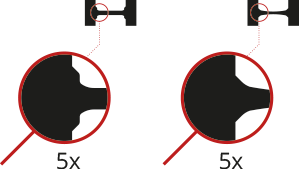
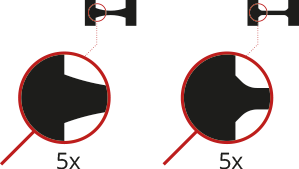
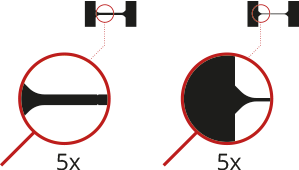
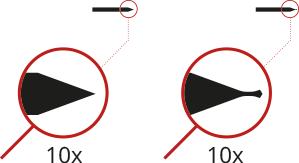
The software-controlled dressing system enables reproducible manufacturing of different rotationally symmetric specimen geometries.
Possible geometries include tensile specimens, tapered geometries, crowned sections, fatigue specimens, and needle-shaped specimens.
Any Material
The fabrication method is highly universal and suitable for a broad range of materials.
Successfully processed materials include metals, alloys, polymers, elastomers, ceramics, composites, biological materials, and bulk metallic glasses.
Workflow of Specimen Preparation
The fabrication technology mainly addresses two different application challenges.
1.
Material and application analysis
2.
Site-specific positioning and alignment
3.
Precision grinding
4.
Optional polishing
5.
Optical dimensional verification
6.
Final inspection
7.
Transfer to testing or delivery